esp32s3-keyboard
Publichhuysqt/esp32s3-keyboard
Loading 3D model… large boards can take a moment.
Thinkpad USB/BLE keyboard based on ESP32S3
This USB/BLE keyboard controller is built upon ESP32S3 (the ESP32S3-WROOM-1 module), which has hardware USB & BLE peripherals. It can support multiple Thinkpad laptop keyboards, if not limited to all sorts of matrix keyboards. The following functions are supported:
- Keyboard & LED;
- Mouse (trackpoint);
- Fn consumer/multimedia keys;
- USB & BLE connection;
- "Low-power": around 6-day BLE connection on a 1500mAh battery;
Tested on T440/T470/E430/E530/E580.
-
E580 keyboard with 3D printed case:
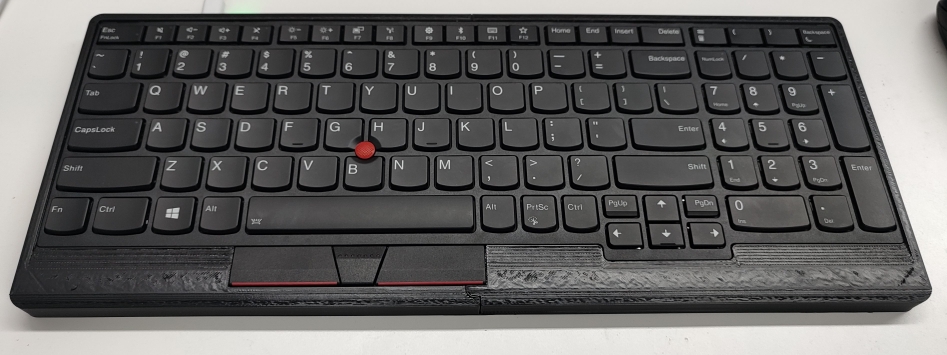
-
T470/T480 keyboard:
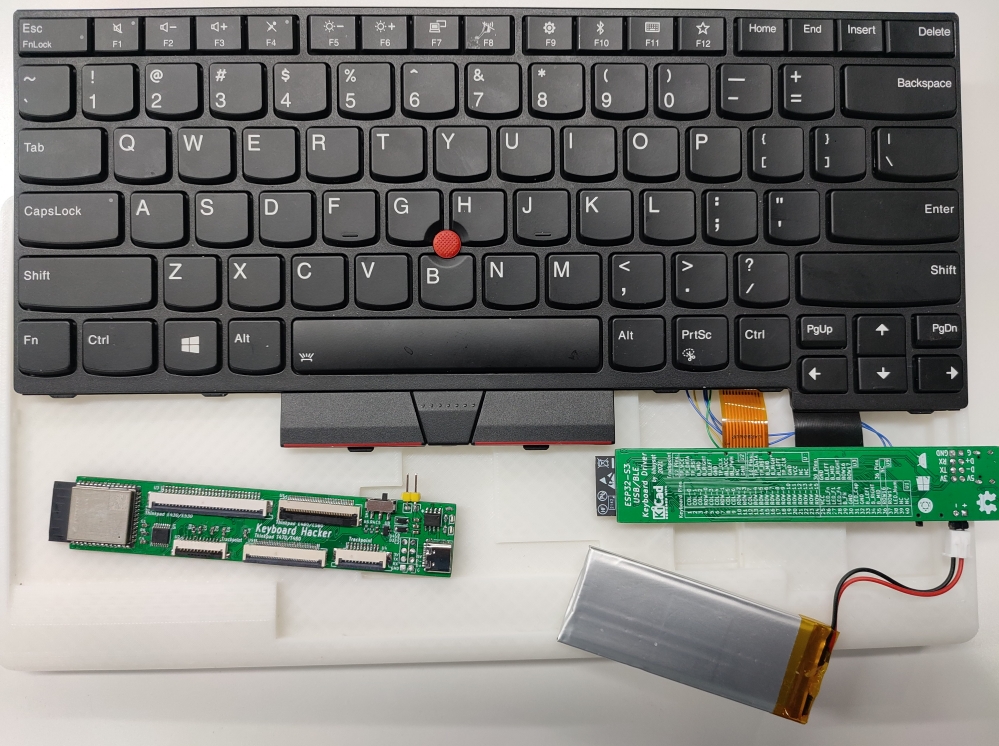
The BLE and USB driver is mainly modified from:
- ble_hid_device_demo in
esp-idf; - tinyusb hid component addon;
Hardware
The Thinkpad keyboard modules are similar. Usually it contains a 32-40 pins FPC cable for keyboard matrix and LEDs, and a 10-12 FPC cable for trackpoint, mouse buttons and backlight. The keyboard matrix comprises 24 or 26 pins, where 8 of them are sense ports and the remaining drive ports. The trackpoint contains 3 input ports for mouse buttons, and a PS2 interface for mouse report. The following pinout is extracted from the E580 schematic.
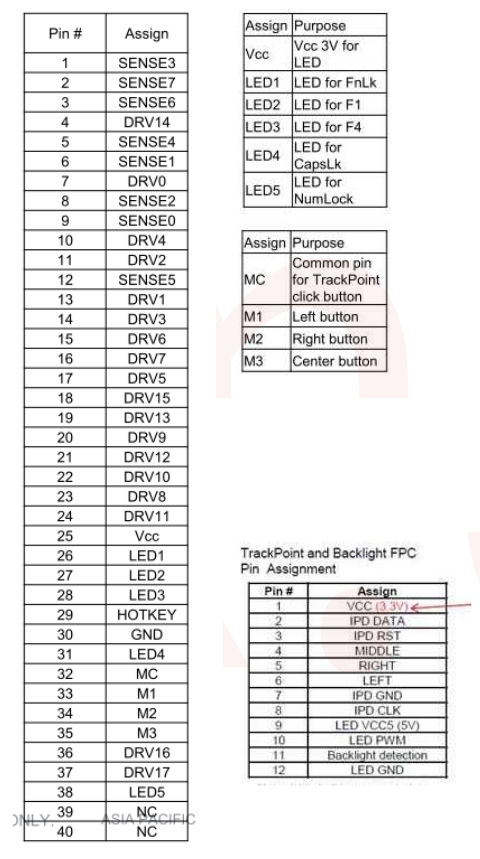
Although ESP32 has no PS2 interface, we notice that the slave-to-host timing of PS2 DATA pin is identical to the UART (1 start bit, 8 data bit, 1 odd parity, 1 stop bit). While by contrast the host-to-slave timing is NOT compatible, this only happens during initialization. Thereby this step requires bit-banging.
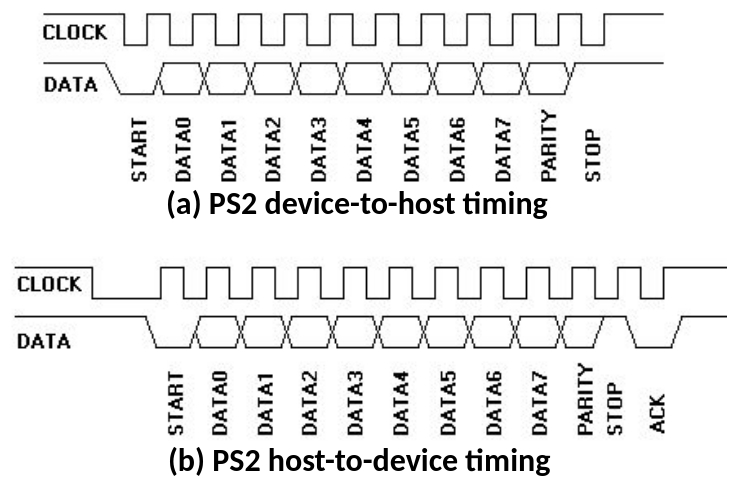
The ESP32S3-WROOM-1 module has 36 GPIOs, among which should reserve the USB port (IO19/20), and the 32.768kHz external oscillator for low-power modem sleep (IO15/16). To fully drive the keyboard matrix, LEDs and PS2 trackpoint mouse, a 74HC138 is used to expand the poor IOs... See the schematic for detail.
- Keyboard: 3 pins for column scanning with 74HC138, plus 18 pins for row sensing;
- Trackpoint: 3 pins (RST, CLK, DATA);
- LEDs: 4 pins (FnLock, CapLk, NumLk, F1, mux with the UART0), plus 1 pin for the keyboard backlight;
- Hotkey/Fn: 1 pin;
- 5V wake up: 1 pin;
- Download Pin: IO0, connected to the middle button;
Build & Run
We build with the normal esp-idf project workflow on Linux:
idf.py set-target esp32s3
idf.py build
To update the firmware, we should first power off the board, hold the middle button, plug in the USB cable, and then we can release the button. The USB-CDC hardware in the ESP32S3 should launch a /dev/ttyACMx on your computer, which can be used to flash the firmware:
idf.py -p /dev/ttyACM0 flash
Finally, unplug the USB cable and power on the board.
Power consumption
The ESP32 is known to be power hungry... We use a 1500mAH battery for the keyboard, and the original ble_hid_device_demo would take over 100mA without midification, which means a poor 15-hour battery life. For lower-power design, we should adopt the BLE modem sleep with external 32kHz crystal under light sleep, which claims an average ~2mA current with ~1000ms BLE connection interval. However, 1000ms (1Hz) interval is too long for real-time keyboard response, and we have to decrease it to around 50ms (20Hz) for normal use. Moreover, the trackpoint/mouse requires a even shorter period, which we set to 12.5ms (80Hz). With this backdrop, we develop a multi-stage power management as follow. This can be configured in keyboard_pm.c.
| Charging | BLE Connect | Keyboard Scanning | Trackpoint | BLE Interval | Current | Duration |
|---|---|---|---|---|---|---|
| No | No | Slow | No | 1000ms | ~5mA | - |
| No | Yes | Slow | No | 1000ms | ~8mA | - |
| No | Yes | Slow | No | 400ms | 13mA | 120s |
| No | Yes | Fast | No | 50ms | 30mA | 240s |
| No | Yes | Fast | Yes (cannot sleep) | 12.5ms | 53mA | 120s |
| Yes | - | - | - | - | -500mA | - |
Note:
- The ESP32 light sleep would force turning off all the peripherals, which means that we will never receive trackpoint message at sleep. So the trackpoint forces no sleep.
- The USB 2.0 host could offer ~500mA current, which means that it takes 3 hours to charge the 1500mAh battery. This is quite a modest setting, and this is why we don't use a larger battery like 2500mAh.
- Backlight takes an additional 50mA.
Battery life estimation (1500mAh):
- 12 days if no BLE connection;
- ~6 days for normal use;
TODO list
- Online configuration;
FnandLeft Ctrlexchange;- Multiple BLE cnnection;
- More keyboards, e.g. X220;
- More OS support, e.g. Mac;
Reference
- How to Make a USB Laptop Keyboard Controller
- Laptop Touchpad/Trackpoint Conversion to USB
- esp32 BLE bridge for mouse and keyboard
- HID scancodes
- Trackpoint hardware
Thinkpad schematics:
No comments yet. Be the first to ask about this board.